
Fully Automatic & Semi-Automatic Machines | Sugarcane Bagasse, Bamboo Pulp & Plant Fiber | Complete Production Line Solutions
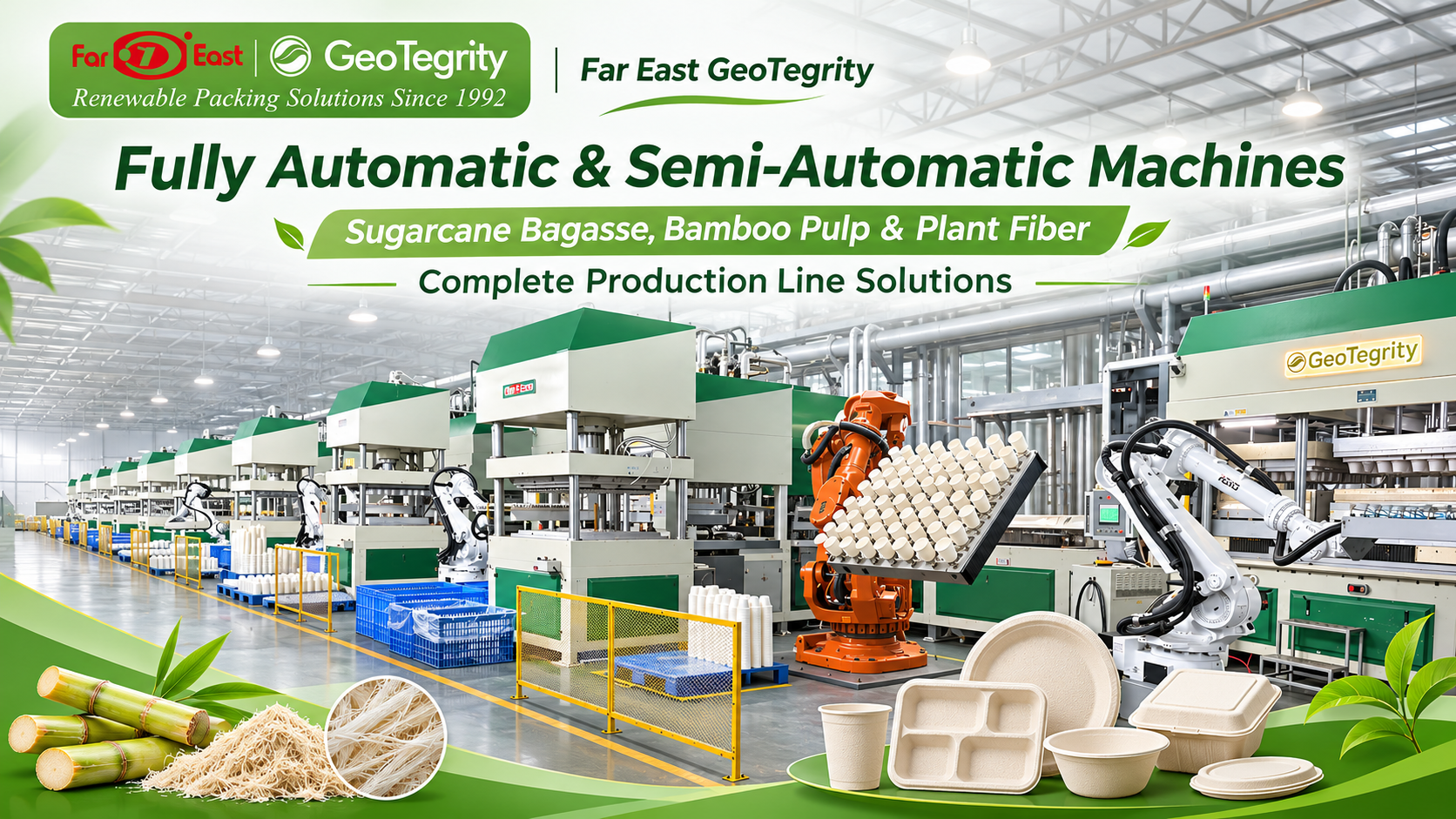
Far East GeoTegrity manufactures pulp molding tableware machines for producing plant-fiber food packaging, including disposable plates, bowls, trays, takeaway containers, cups, and lids.
Founded in 1992, we combine machinery development, mold manufacturing, and hands-on tableware production experience. Our equipment range includes fully automatic and semi-automatic
machines, supported by production line engineering, installation guidance, commissioning, and operator training.
Whether you are starting a bagasse tableware factory or upgrading an existing production line, we help you select equipment based on the products you want to manufacture, your daily output requirements, and the practical conditions of your factory.
Explore Our Machines | Request a Production Line Proposal
What Is a Pulp Molding Tableware Machine?
A pulp molding tableware machine is industrial equipment used to convert prepared plant-fiber pulp into molded food packaging products.
The machine uses forming molds, vacuum, heat, and pressure to shape pulp into products such as plates, bowls, food containers, and cup lids.
Unlike conventional plastic injection molding, pulp molding starts with a water-based fiber suspension. The fibers are formed into a wet product, transferred for hot pressing, and processed into the required shape and surface finish.
The production method is particularly suitable for manufacturers working with sugarcane bagasse, bamboo pulp, and other compatible plant fibers.
However, not every pulp molding machine is designed for the same application. Equipment used for egg trays or industrial protective packaging may differ considerably from machines designed to produce smooth, dimensionally accurate food-contact tableware.
For food packaging manufacturers, mold precision, forming consistency, hot-press performance, and product handling are important considerations when selecting a machine.
Our Pulp Molding Tableware Machine Range
Far East GeoTegrity offers different machine configurations to support varying production requirements, factory conditions, and investment plans.
SD-P21 Fully Automatic Pulp Molding Tableware Machine
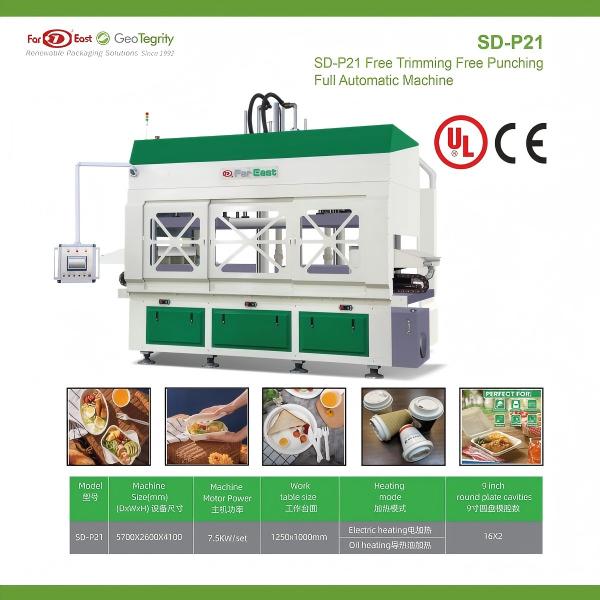
The SD-P21 is designed for automated production of molded fiber food packaging, with a particular focus on reducing secondary processing.
Its free-trimming and free-punching technology allows suitable products to be formed without conventional downstream edge-trimming and hole-punching operations.
The production sequence integrates forming, hot pressing, product transfer, and stacking.
Depending on the configuration, automated visual inspection can also be incorporated into the production workflow.
Key features:
·Fully automatic forming and hot pressing
·Trimming-free and punching-free process for compatible product designs
·Automated product transfer and stacking
·Optional integration with visual inspection systems
·Suitable for selected plates, bowls, containers, and lids
·Designed to reduce repetitive manual handling
For a specified SD-P21 production configuration, daily finished-product output can reach approximately 800 kg under defined operating conditions.
Actual production capacity depends on the product weight, mold cavities, cycle time, operating hours, and production yield.
SD-P22 Fully Automatic Pulp Molding Tableware Machine
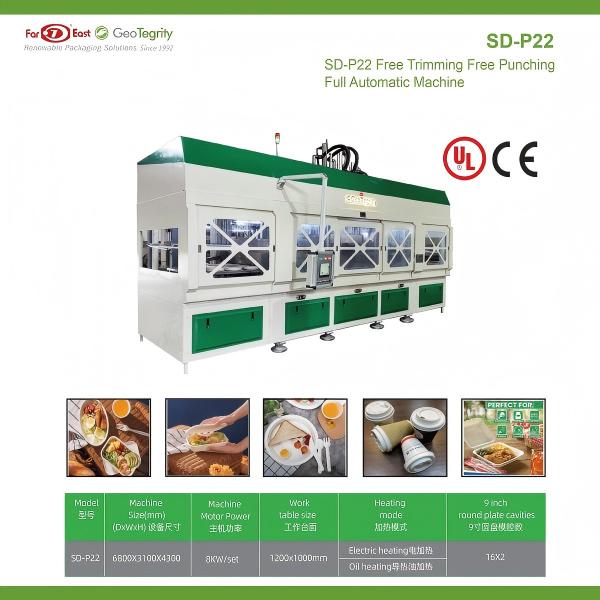
The SD-P22 is another fully automatic option in Far East GeoTegrity’s molded fiber tableware equipment range.
It is intended for manufacturers evaluating automated production of plant-fiber food packaging.
Machine selection should consider the required product dimensions, mold configuration, production volume, and available factory utilities.
Our engineering team can help compare SD-P21 and SD-P22 configurations against your product samples and production targets.
LD-12 Fully Automatic Pulp Molding Machine
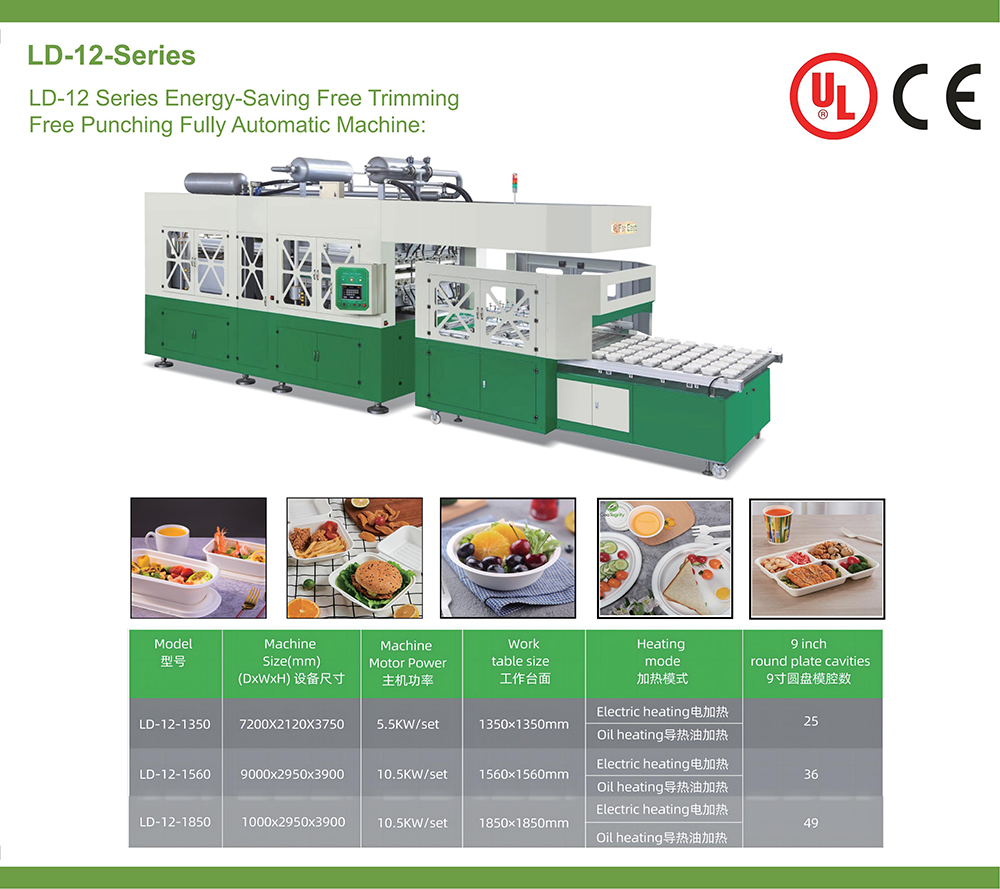
The LD-12 series provides additional fully automatic machine options for molded fiber tableware production.
Different LD-12 configurations can be evaluated according to mold requirements, product dimensions, heating arrangements, and production planning.
This series may be considered by manufacturers looking to expand an existing molded fiber production operation or establish a new facility.
Semi-Automatic Pulp Molding Tableware Machines
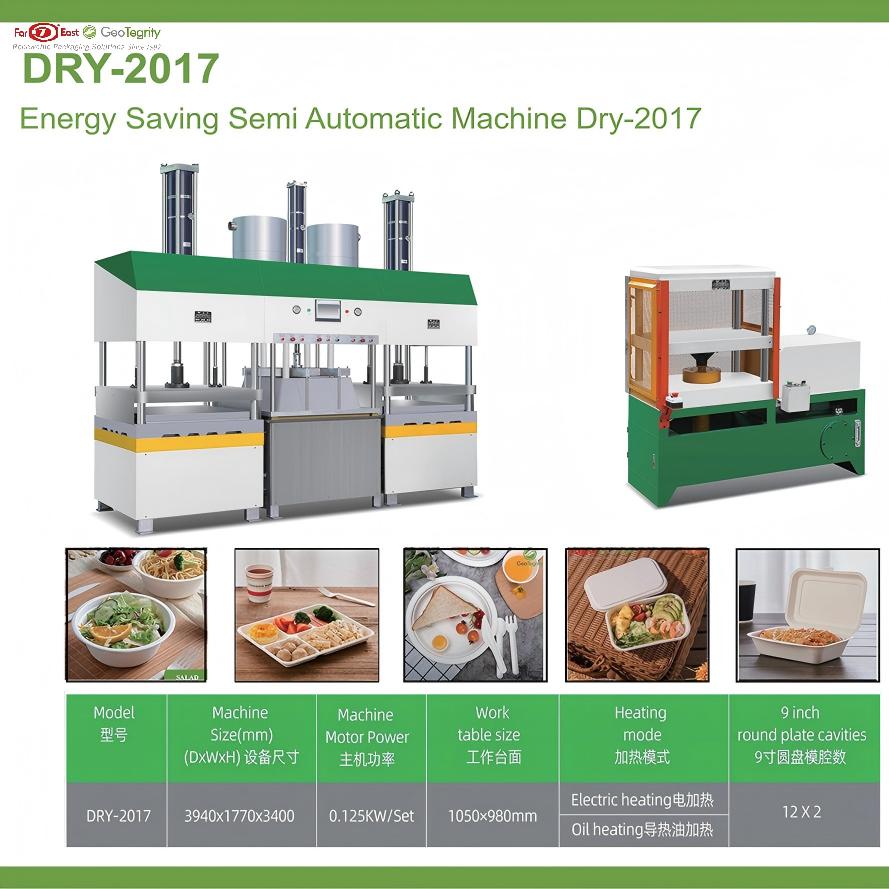
Semi-automatic machines remain an option for manufacturers whose production plans favor a different balance of initial investment, automation, and labor involvement.
Compared with a fully automatic production line, a semi-automatic configuration may require more operator participation in product handling or related operations.
The appropriate choice depends on local labor costs, expected production volume, product variety, and the intended operating model.
Not sure which machine is suitable?
Send us your target product dimensions, product weight, expected daily output, and preferred raw material. Our team can review the requirements before recommending a machine configuration.
How Does a Pulp Molding Tableware Machine Work?
A molded fiber tableware production line involves several connected processes. Stable finished-product output depends on how these processes work together.
Step 1: Pulp Preparation
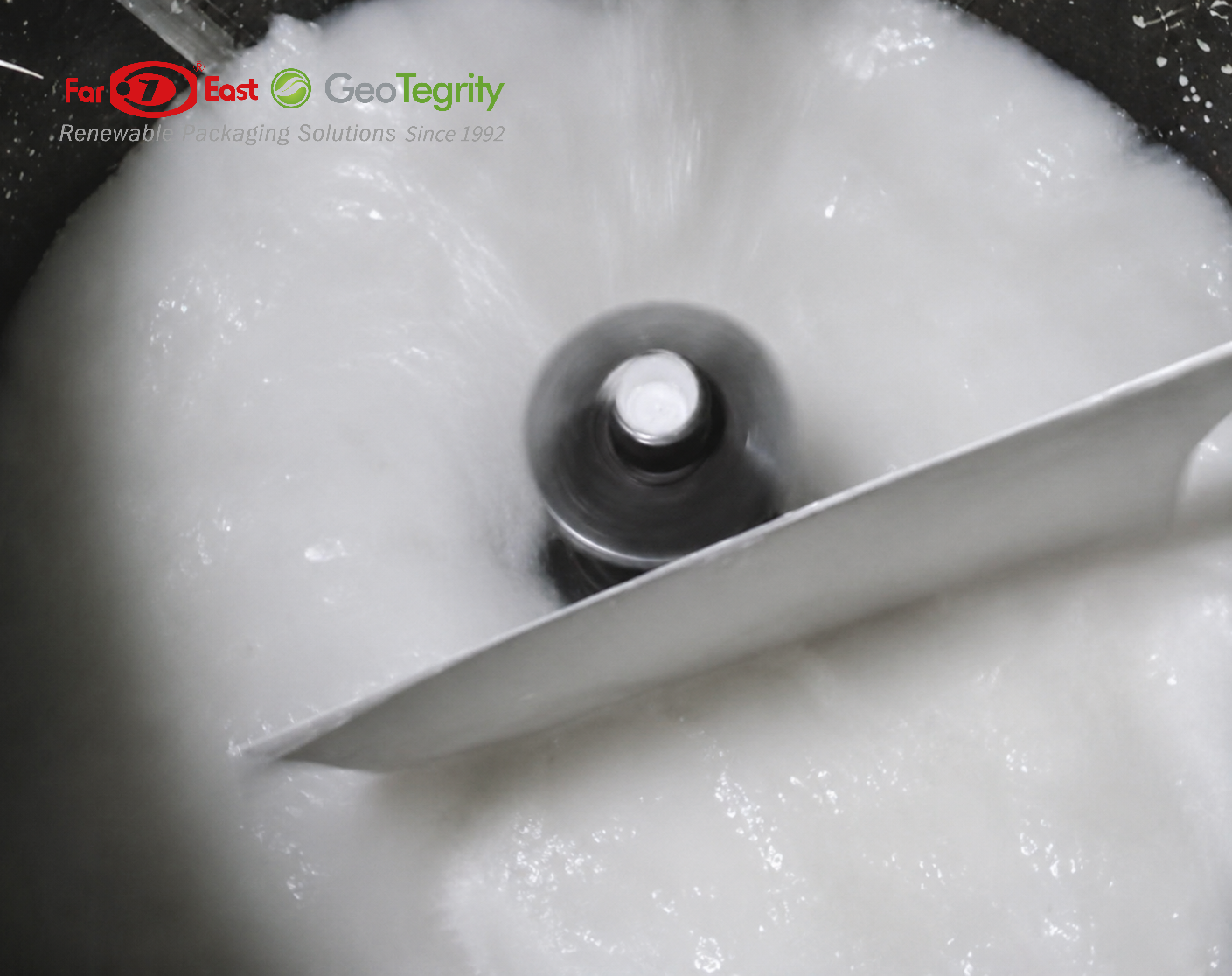
The production process begins with preparing the required fiber pulp.
Sugarcane bagasse, bamboo pulp, wood pulp, and other compatible fibers can be evaluated according to product requirements.
The pulp preparation system helps establish the required fiber consistency and supplies the forming machines.
Pulp formulation and additives must be selected according to the intended food-contact application and destination-market requirements.
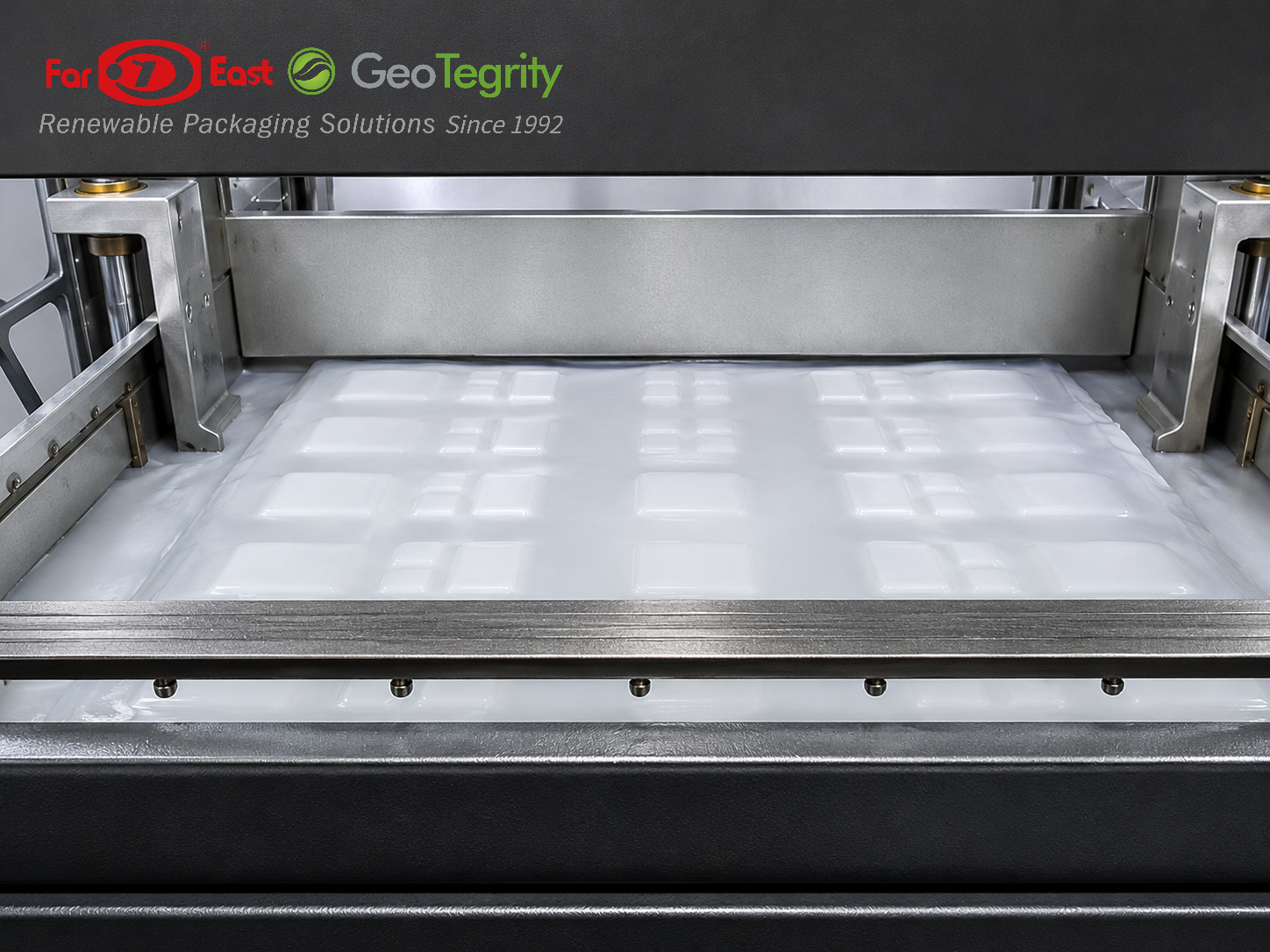
Step 2: Vacuum Forming
Prepared pulp enters the forming system.
A forming mold and vacuum system distribute and retain fibers on the mold surface, creating the wet product shape.
Mold design, pulp consistency, vacuum performance, and forming time influence product weight distribution and forming consistency.
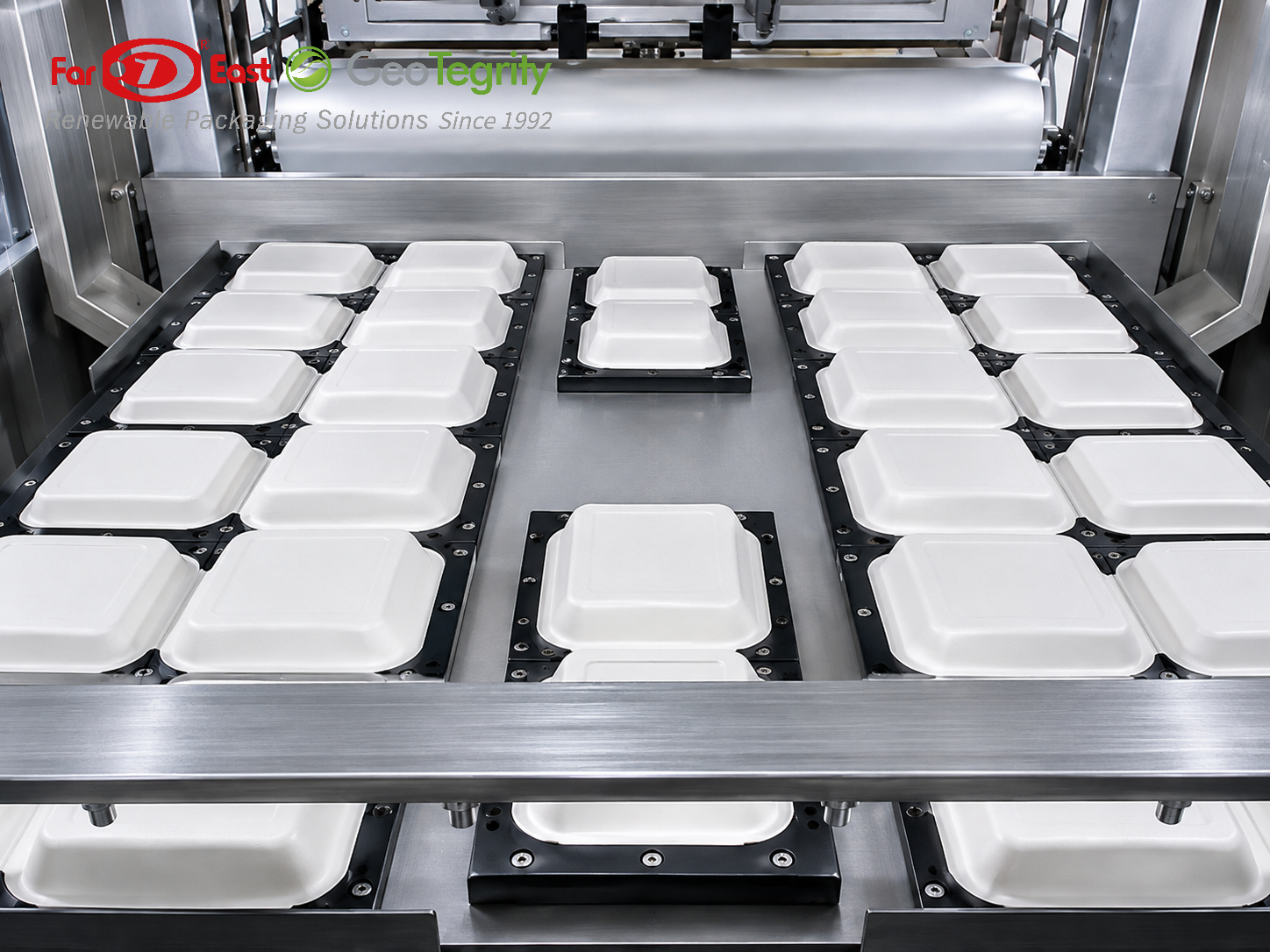
Step 3: Hot Pressing
The wet molded product is transferred to the hot-pressing stage.
Controlled heat and pressure remove moisture and help produce the required product shape, surface finish, and dimensional stability.
Pressing parameters must be matched to the product design, material formulation, and equipment configuration.
Step 4: Product Transfer and Finishing
After hot pressing, the finished or near-finished product moves to the next operation.
Some machine configurations require trimming or punching, while compatible trimming-free systems can eliminate these secondary steps.
The need for additional processing depends on the product design and production method.
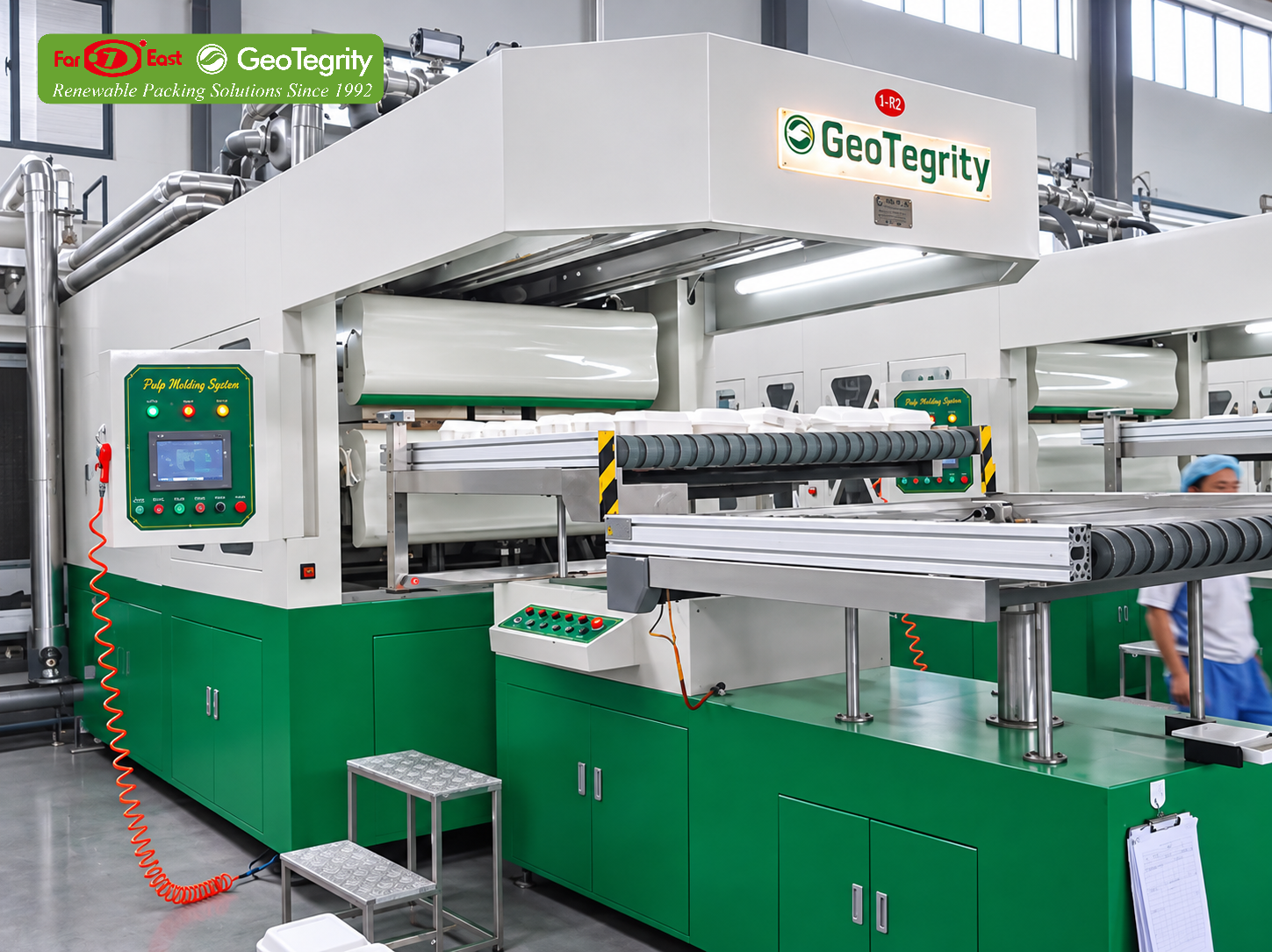
Step 5: Inspection and Stacking
Products are inspected for defects such as incomplete forming, visible damage, or dimensional inconsistencies.
Depending on the line configuration, inspection and stacking may be performed manually or through automated systems.
The finished products are then ready for counting, packing, and subsequent quality checks.
What Products Can a Pulp Molding Tableware Machine Produce?
Far East GeoTegrity equipment supports the manufacturing of various molded fiber food packaging products.

Bagasse Plates and Bowls
Molded fiber plates and bowls are widely used in foodservice, catering, and takeaway packaging.
Product dimensions, depth, wall thickness, and weight influence mold design and production capacity.
Takeaway Containers and Clamshells
Single-compartment and multi-compartment containers require careful control of forming consistency, product dimensions, and closing performance.
For hinged containers, the hinge and closure design should be evaluated during mold development and sample testing.
Food Trays
Molded fiber trays can be developed for food packaging applications, including products intended for additional barrier treatments or compatible sealing solutions.
Tray dimensions, flange design, and the intended packaging process should be considered before selecting molds and equipment.
Cups and Cup Lids
Cup and lid production requires attention to product dimensions, rim geometry, and fit.
For cup lids, physical assembly testing is important because small dimensional differences can affect closing performance and user experience.
One machine does not automatically produce every product shape. Product changes require compatible molds, and some products may require a different machine configuration or additional processing equipment.
How Much Can a Pulp Molding Tableware Machine Produce Per Day?
Daily output is one of the most important questions when evaluating a pulp molding tableware machine.
However, capacity should not be judged by machine size or a single advertised production figure.
The finished-product output depends on several factors:
·Number of cavities in the production mold
·Product weight and geometry
·Forming and hot-pressing cycle time
·Daily operating hours
·Production yield
·Mold-change and maintenance downtime
Understanding Kilograms per Day and Pieces per Day
A machine rated at 800 kg of finished products per day does not produce the same number of pieces for every product.
For example:
| inished Product Weight | Theoretical Pieces at 800 kg/Day |
| 10 g | 80,000 |
| 15 g | 53,333 |
| 20 g | 40,000 |
| 25 g | 32,000 |
| 40 g | 20,000 |
These figures illustrate the relationship between finished-product weight and total daily output. They are not independent production guarantees for each product type.
A second calculation can be made from the mold configuration:
Daily pieces = Mold cavities × Cycles per hour × Operating hours × Production yield
For example, a hypothetical 12-cavity mold operating at 120 cycles per hour for 20 hours with a 98% finished-product yield would produce approximately 28,224 acceptable pieces per day.
Actual results must be verified against the machine model, product specifications, and operating conditions.
For investors, both kilograms per day and pieces per day should be included in the equipment proposal.
Fully Automatic vs. Semi-Automatic Pulp Molding Tableware Machines
The choice between fully automatic and semi-automatic equipment affects factory layout, labor planning, production consistency, and long-term operating costs.
| Comparison | Fully Automatic | Semi-Automatic |
| Product handling | More automated | More operator involvement |
| Labor requirements | Generally lower for comparable operations | Generally higher |
| Initial equipment investment | Typically higher | Typically lower |
| Production workflow | More integrated | More dependent on manual operations |
| Production planning | Suitable for automated, repeatable production | May suit different investment and operating conditions |
| Best fit | Automation-focused operations | Projects prioritizing a different capital and labor balance |
Neither configuration should be selected on purchase price alone.
A lower initial equipment cost may be offset by additional labor or downstream processing. Conversely, a more automated line requires an investment that should be justified by the expected production volume and operating conditions.
Our team can review both options based on the customer’s intended products and business plan.
Complete Pulp Molding Tableware Production Line Solutions
A forming machine is only one part of a complete molded fiber tableware factory.
A production line also needs reliable pulp supply, utilities, molds, product handling, and quality control.
Far East GeoTegrity provides production line planning and equipment solutions that can include the following systems.
Pulp Preparation and Supply
The pulp preparation system processes and supplies fiber pulp to the forming machines.
The design depends on raw material characteristics, required pulp consistency, and total production capacity.
Forming and Hot-Pressing Equipment
The forming machines and hot presses are selected according to the product range, required daily output, and production workflow.
Vacuum and Compressed Air Systems
Vacuum equipment supports fiber forming and water removal. Compressed air supplies pneumatic operations where required.
Both systems must be sized according to the actual machine configuration.
Heating and Temperature Control
The heating system provides the thermal energy required for hot pressing.
Available heating arrangements and their operating costs should be evaluated against local utility conditions and the selected equipment.
Molds and Product Development
Mold design has a direct influence on product dimensions, forming quality, release performance, and production efficiency.
Far East GeoTegrity develops molds alongside its pulp molding equipment solutions.
Water Circulation and Supporting Utilities
Water circulation, piping, electrical distribution, and other supporting systems should be considered during the factory planning stage.
Inspection, Stacking, and Packaging
Depending on the production requirements, the line can incorporate automated transfer, inspection, and stacking operations.
The complete configuration should reflect the customer’s production volume, quality requirements, and available labor.
How to Choose the Right Pulp Molding Tableware Machine
A reliable equipment selection process starts with the product, not the machine catalog.
1. Define Your Target Products
Identify the exact products you plan to manufacture.
For each product, provide dimensions, target weight, material, and expected order volume.
If samples or technical drawings are available, they can help the engineering team evaluate mold feasibility.
2. Calculate Your Required Output
Determine your target production volume in both kilograms and pieces per day.
A factory producing lightweight lids may require a different mold and machine configuration from one producing large takeaway containers.
3. Evaluate Raw Material Availability
Check the local availability and consistency of sugarcane bagasse pulp, bamboo pulp, or other suitable fibers.
Raw material characteristics can influence forming behavior, finished-product quality, and operating cost.
4. Compare Automation and Labor Requirements
Evaluate the number of operators required, the degree of automatic product handling, and the need for secondary processing.
For a meaningful comparison, use the same target products and operating hours across different machine proposals.
5. Review Factory Utilities
Before finalizing the equipment configuration, confirm the available electrical supply, water, compressed air, heating utilities, and factory space.
Utility requirements should be calculated from the complete production line rather than the main forming machine alone.
6. Verify Product Samples and Machine Performance
Request production samples or a trial plan for the intended products.
Important evaluation points may include product weight consistency, dimensional accuracy, visual quality, and applicable functional tests.
For lids and containers, fit and closure testing may be particularly important.
7. Evaluate Long-Term Support
Consider mold development, spare parts, installation guidance, operator training, commissioning, and maintenance support.
These services can be as important as the equipment itself when establishing a new production facility.
What Determines the Price of a Pulp Molding Tableware Machine?
There is no single price that applies to every pulp molding tableware machine.
Equipment quotations depend on the machine model, automation level, mold configuration, heating system, production capacity, and included auxiliary equipment.
A quotation for a standalone forming machine should not be compared directly with a proposal for a complete production line.
When evaluating an investment, consider:
·Main forming and hot-pressing equipment
·Production molds and spare molds
·Pulp preparation system
·Vacuum and compressed air equipment
·Heating and water circulation systems
·Product transfer and stacking equipment
·Installation and commissioning
·Freight, duties, and local infrastructure
·Operator training and spare parts
For an accurate quotation, we recommend providing your target products, daily production capacity, project country, and intended production schedule.
Why Choose Far East GeoTegrity?
Pulp Molding Technology Since 1992
Far East GeoTegrity has worked in plant-fiber molding technology and equipment manufacturing since 1992.
Our experience covers machinery development, production molds, and the manufacturing of molded fiber food packaging.

Experience Beyond Equipment Manufacturing
We understand pulp molding from both the equipment and finished-product perspectives.
Operating molded fiber tableware production facilities provides practical experience with production efficiency, product quality, maintenance, and process optimization.
This experience helps inform our approach to machine design and production line planning.
Equipment and Mold Development
Equipment and molds must work together.
Our technical team evaluates product geometry, production requirements, and mold configuration as part of the machine selection process.

Automated Production Technology
Our equipment range includes fully automatic machines and configurations designed to reduce manual handling and secondary processing.
For compatible applications, trimming-free and punching-free technology can simplify the manufacturing workflow.
Production Line Engineering
We support customers with equipment selection, production line planning, workshop layout, installation guidance, commissioning, and operator training.
The scope of each project is determined by the customer’s requirements and the agreed equipment supply.
International Project Experience
Far East GeoTegrity has supplied pulp molding equipment and technical support to customers in different international markets.
Our project experience includes production line installation, commissioning, and support for molded fiber food packaging manufacturers.
Renewable Packaging Solutions Since 1992.
Frequently Asked Questions About Pulp Molding Tableware Machines
What is a pulp molding tableware machine used for?
A pulp molding tableware machine produces molded fiber food packaging from prepared plant-fiber pulp. Typical products include plates, bowls, trays, takeaway containers, cups, and lids. The specific product range depends on the machine and mold configuration.
What raw materials can be used in a pulp molding tableware machine?
Common raw materials include sugarcane bagasse pulp, bamboo pulp, and wood pulp. Other plant fibers may be suitable after evaluating their characteristics and compatibility with the intended process.
How much does a pulp molding tableware machine cost?
The price depends on the machine model, automation level, production capacity, molds, heating system, and included auxiliary equipment. A complete production line requires a broader investment than a standalone machine. A project-specific quotation is the most reliable way to compare costs.
How many plates can a pulp molding machine produce per day?
Daily output depends on the plate weight, mold cavities, cycle time, operating hours, and production yield. For illustration, 800 kg of finished products is equivalent to 40,000 pieces weighing 20 g each. Actual machine performance must be verified for the selected product.
Can one machine produce plates, bowls, and food containers?
A machine may support different products through compatible mold changes. However, product dimensions, geometry, and process requirements must be checked. Not every product can be manufactured on every machine.
What is the difference between a fully automatic and a semi-automatic pulp molding machine?
Fully automatic machines integrate more production and product-handling operations, while semi-automatic machines generally require greater operator involvement. The best option depends on production volume, labor costs, capital budget, and factory requirements.
Does a pulp molding tableware machine need a trimming process?
Some molded fiber products require trimming or punching after forming. Compatible trimming-free and punching-free equipment can eliminate these operations for suitable product designs. The required process depends on the machine, mold, and finished-product specifications.
What equipment is needed for a complete bagasse tableware production line?
A complete line typically includes pulp preparation, pulp supply, forming and hot pressing, molds, vacuum, compressed air, heating, water circulation, and product handling systems. Inspection, stacking, and packaging equipment may also be included.
How much electricity does a pulp molding tableware machine consume?
Electricity consumption depends on the machine configuration, heating method, production schedule, and auxiliary systems. Installed electrical power should not be confused with actual operating consumption. A reliable estimate requires a complete equipment and utility configuration.
Can pulp molding machines manufacture compostable tableware?
Pulp molding machines can manufacture plant-fiber tableware intended for compostable packaging applications. However, finished-product compostability depends on the material formulation, additives, coatings, and applicable testing standards. The machine alone does not establish compostability certification.
How do I start a sugarcane bagasse tableware manufacturing factory?
Begin by defining your target products, production capacity, raw material supply, factory location, and investment plan. The next step is to evaluate equipment, molds, utilities, factory layout, labor requirements, and product testing. An engineering proposal can then be developed around the project’s requirements.
Does Far East GeoTegrity provide complete production line solutions?
Yes. Far East GeoTegrity provides pulp molding equipment, molds, production line planning, and related technical services. Project support can include workshop layout, installation guidance, commissioning, training, and after-sales assistance, depending on the agreed scope.
Plan Your Pulp Molding Tableware Production Project
Every molded fiber tableware project begins with a different combination of products, production targets, and factory conditions.
Far East GeoTegrity can help you evaluate suitable equipment and production line configurations before you make an investment decision.
To discuss your project, please share:
·Target products and product dimensions
·Estimated product weight
·Required daily output
·Preferred raw material
·Project country and factory location
·Planned production schedule
·New factory or existing production line
Request a Machine Quotation
Discuss Your Production Line with Our Engineering Team
Far East GeoTegrity — Renewable Packaging Solutions Since 1992.

Post time: Nov-16-2026